Cetus2 Reviews: See Why 0 Shoppers Rated It 0 Stars!
Everyone’s got opinions. We collected 0 of them to see if the Cetus2 3d printer really earns that 0/5 rating.
 Supermod
 Moderator
 Recaptor
Cetus2: A Sophisticated 3D Printer Built for Enthusiasts and Professionals
The Cetus2 emerges as a noteworthy contender in the world of 3D printers, particularly for those who need a reliable desktop machine for complex projects such as prototyping, miniatures, and engineering models. Built primarily for intermediate to advanced users, this prebuilt FDM/FFF 3D printer offers an intriguing combination of precision, dual extrusion capabilities, and user-friendly features that can transform creative concepts into tangible realities. On paper, the Cetus2 delivers a solid build volume and power efficiency indicative of a carefully engineered device, promising quality, speed, and versatility within a compact footprint.
Detailed Specs & Features
According to specs, the Cetus2 boasts a build volume of 356 cubic inches, with the capacity to print objects measuring up to 7.87 inches wide, 11.81 inches deep, and 11.81 inches high. This sizeable build width enables users to tackle varied projects without compromising on detail. The machine runs on an internal power supply, accommodating voltages from 110 to 240 volts, ensuring it can operate efficiently worldwide. Its maximum extruder temperature reaches 536°F (280°C), which supports a healthy range of filament types like PLA, PVA, PETG, and TPU, all printed from 1.75mm filament diameter.
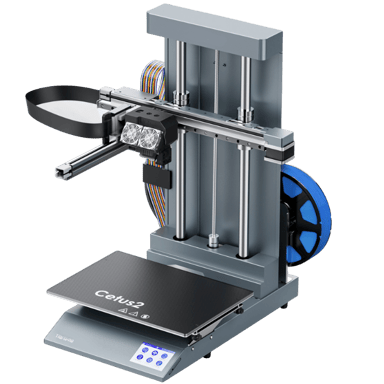
Speaking of filament, the Cetus2 is designed for dual extrusion printing, meaning it can handle two materials at once while providing users with quick-swap nozzle capability and a standard nozzle diameter of 0.4 mm. The direct drive extruder is well-suited for flexible filaments, enhancing printing versatility. Additionally, users will appreciate the built-in auto bed leveling system, which simplifies setup and ensures consistent first-layer adhesion on its smooth glass build plate.
User Experience & Performance (Based on Specs)
Design & Build
The Cetus2 measures around 18.5 inches wide, 18 inches deep, and 23.6 inches tall, weighing just over 33 pounds, making it reasonably compact for desktop use. Thanks to its folded dimensions, it becomes even easier to store or transport. This Cartesian frame printer features an open enclosure, so ventilation is ample, but it affects whether users can print certain temperature-sensitive materials.
The printer's Cartesian frame with belts and rods provides reliable motion control and accuracy, with a noise level of 50 dB during operation, which is moderate but manageable in small workspaces. Its 3.5-inch touchscreen display, featuring a 480x320 pixel resolution, allows intuitive control and monitoring without requiring external devices.
Performance
In daily use, the Cetus2 performs competently with a max print speed of 300 mm/s officially, though realistic effective speeds tend to hover around 120 mm/s, balancing quality and time. The device hits a print accuracy near 100 microns, which aligns well with demands for detailed miniatures and engineering prototypes. The print recovery functionality acts as a safety net against interruptions such as power loss, improving reliability for longer projects that can last up to 72 hours continuously.
This model's print adhesion method employs durable PEI sheets that ensure prints stick firmly to the plate while being easy to remove post-printing. However, it lacks a heated chamber, so users should consider ambient temperature controls for optimal material performance. The absence of filament drying requirements combined with an auto-loading feature further streamlines the user workflow.
Connectivity & Software
The Cetus2 supports multiple connectivity options such as USB, Wi-Fi, and SD card interfaces, offering flexible file transfer methods. It works with well-known slicers, including Cura, Simplify3D, and Repetier-host, without forcing proprietary software use, which adds a degree of freedom for users with established workflows. Firmware updates are possible but must be done manually, as remote updates are not supported.
Extra Features
The printer benefits from several safety certifications like CE, FCC, and RoHS, reflecting its compliance with international safety and environmental standards. It includes overheat protection and an auto shutdown feature on error to minimize risks during unattended operation. Although it doesn't come with air filtration or enclosure locking, the presence of dual safety sensors adds confidence in operational security. The machine's printing ecosystem doesn't embrace resin workflows, which is consistent with its FDM focus but may limit those seeking multi-technology capabilities.
Pros & Cons
Pros
- Robust dual extrusion support with quick-swap nozzles
- Compact yet generous build volume for most consumer projects
- Multiple connectivity options with broad slicer compatibility
- Strong safety certifications and overheat protection features
Cons
- No heated chamber, limiting material versatility
- Lacks remote monitoring and cloud software integration
- No filament dry box or resin compatibility
- Absence of print farm or multi-user management tools
Price & Value For Money
With a price tag of around $628.4 at GeekBuying, the Cetus2 positions itself strategically against other advanced FDM printers. Given its undisclosed warranty period and comprehensive features like dual extruders, auto bed leveling, and a sizable touchscreen, this seems like a reasonable investment. For users targeting improved print precision and material flexibility without stepping into industrial prices, it's a balanced choice. Still, those who require high-end features such as heated chambers, cloud integration, or multi-unit management might find the limitations noteworthy.
Quick Take
In short, the Cetus2 is a solid workhorse for intermediate and advanced 3D printing enthusiasts who prioritize dual extrusion and reliable print quality within a manageable desktop size. If we look at the numbers alone, its build volume, power efficiency, and filament compatibility set a strong foundation for creative workflows that demand flexibility and precision.
Closing Recommendation
For those who want a capable and efficient dual-extruder system without the fuss of jerky assembly or complex software ecosystems, the Cetus2 may be ideal. It appears to perform best in environments where user experience and print consistency are key, helping users achieve detailed, multi-material prints reliably at a competitive price. However, professionals seeking cutting-edge automation or resin printing versatility may need to look elsewhere.
Verdict
Rating: Based on the specifications and overall feature set, we believe Cetus2 deserves 4.1 out of 5.
- Winner Feature => Efficient dual extrusion with quick-swap nozzles enables multi-material printing with user-friendly maintenance.
- Needs Improvement => Missing a heated chamber and advanced connectivity options limit high-end material support and professional fleet management.
Reviews 0
The good, the bad, and the brutally honest.Average Rating


More 3D Printers 453
Unlock more awesome finds.